Wednesday, September 14, 2011

First Day of Red Bison Work

Hello everyone,

This past Sunday I got to participate in pulling out woody plants from a prairie area somewhat near the university. It was a lot of fun and I got to learn quite a bit about the general ecology about prairies and their eventual migration to becoming forested areas. This is not something that can normally be seen, but it was obvious in the area that we were in because on one side you could see where the trees/shrubs were truly beginning to grow and usurp control from the prairie by creating shade. That is where the Red Bison comes in.

There were about a dozen of us and we took it to the trees/shrubs that were beginning to grow. The area we were working on actually belongs to the railroad company, but they have been good enough to let us use it and work on it to preserve what natural prairie we can. Armed with loppers and mild herbicides, we ventured out into the overgrown zone with determination to root out (no pun intended) as many woody plants as we could.

There were many, great and small, but we attacked them with gusto and managed to make quite the dent in the woody plant population. Now their bodies lay next to the railroad tracks as a sign that the Red Bisoneers were here and have done their work well. We fought hard to pry through the brambles and other thorny things to get to the offending trees and take them down.


These brambles were everywhere and no one was able to escape unscathed. I myself came out scratched all over and almost got a lovely, free ear piercing when I stood up after taking down a tree using a technique my old high school teacher taught me. Still left a decent hole and scratch, but not too bad overall. It will heal soon enough.

As a show of how entrenched some of these woody plants were, some had dead stumps where they had been taken down in the previous year or two, but grew new stumps up right around the dead one. Myself and two other Bisoneers spent a good 10 minutes fighting with a hawthorn tree that had gotten much too comfortable growing there. But despite its thorny defenses, we prevailed and took down the multiple stumps it had sent up and victoriously tossed them to the side where they belonged.

Besides the victory of taking down plant after plant, there were many other interesting things to be found. One girl found a praying mantis as she waded into the brambles and a small group found a large grasshopper (at least 4th instar, possibly adult) on one of the offending trees. I had the joy of finding many different insects and arachnids, including four juvenile yellow garden spiders (argiopes). I apologize to any Bisoneers that read this because I mislabeled this spider as a silver argiope on the trip.


Juvenile Yellow Argiope (Argiope aurantia)

Overall, a very fun trip and I am happy that I was able to bloody myself again doing something that enjoyable (and helpful!). Very much looking forward to doing it again, along with whatever plans the Red Bison club has!

Keep your eyes and ears open for opportunities to help. You never know what you'll see.

Bug

Thursday, September 1, 2011

Musseling

Hello everyone,

I'm sorry it has been so long since I last posted. I've been busy with a summer class and then moving into along with beginning classes at the University of Illinois down in Urbana-Champaign. It's been pretty enjoyable so far, which is a good thing since this is where I'll be spending the next four years of my life, getting my Bachelor's and then Master's degree. Posts may be a little more sporadic since I will be making sure things are straight with my classes, but I will still do my best to post regularly and that may be a little bit easier since I have joined a couple clubs that will get me outside and doing things. And hopefully the occasional fun volunteering opportunity will crop up now and then and I will get to experience new things and learn so much more about this amazing world we live in.

This past Saturday, I got to take part in a state wide survey of the mussel populations of Illinois. This meant that I (along with 21 others), got to wade through Sangamon River, crouched down so the water is easily halfway up the chest, hands buried knuckle-deep in the sediment on the bottom, searching for the many species of mussels that inhabited the river. Now I know that might not sound like an ideal way to spend a Saturday, but let me assure you, it was well worth it. It was a great experience and I was very happy to have taken part in it.


Very wet and dirty work, but so much fun (photo by Steve Buck)


One of the first things I learned about musseling is there are quite a few more species than you would think there are. I thought there would be one, maybe two, different species that we would find and they would be just a drab coloration of the river bottom. But let me tell you, we found much more than that.

Quite a representation of the variation I think (photo by Steve Buck)


As a group, we ended up collecting 318 mussels from 14 different species. Overall, I thought that was a pretty good count, though our group leader said that the species number was a little low. I couldn't believe the differing sizes and colors of the mussels we pulled out.

The first area we searched involved a splitting of the group. Half of us went upriver and the other half went downriver. I had the joy of being with the upriver group because we definitely had some fun searching. We all were focused on the task at hand, but still had some fun conversation and were even joined by a surprising (though very friendly) guest.

Our new friend (photo by Steve Buck)

We never did figure out who's dog that was, but he a very friendly acquisition to the team. The only issue we really could find with him was fetching preferences were a little odd (he would chase after literally everything we threw to the side no matter what it was) and when he did go after something and grab it, he would pretty much drop it where he grabbed it. Nevertheless, we enjoyed having him around and got some chuckles later when we were sorting mussels and he flushed out a raccoon from a nearby pile of debris that had washed downriver.

Now some of you may be thinking "Boy, that seems like it would be pretty cold and dirty, disgusting work". Was the water cold? At times it was, depending on where you were in the river. The deeper water was certainly colder than the shallows, but the deeper water was where many mussels were, so it made getting water up to my shoulders while I was crouching down worth it. As for dirty...yeah. I may end up just throwing my socks away because even after washing a couple times, they are still a lovely shade of brown. There is still sand embedded in my shirt and shorts I was wearing that day and I will probably never completely get the sand out of my shoes. Sometimes the river bottom seemed a little gross because of the change in composition from sand or gravel to a clay-like sediment, but it really wasn't all that bad, so I say that it wasn't at all disgusting.

Besides the joys of wading for an hour and a half, I did pick up some other interesting ecological tidbits that broaden my view and get me to think a little bit more. But those are things I will share with you all another day.

The Musseling Group and our best specimens (photo by Steve Buck)


This was a grand experience and I hope to have the opportunity to take part in many more like it. I enjoyed musseling with this group and hope to do other random biology volunteer work with them again sometime.

Keep your eyes open for new things everyone. You never know what you may come across and what may surprise you with beauty or uniqueness.

Bug

Sunday, August 14, 2011

A Pleasant Suprise

Hello everyone,

I had quite the suprise when I was going out my back door to take a dip in the pool.

I wear glasses normally, but take them off when I am going swimming. Needless to say, my vision is a bit affected by this change, so seeing things that aren't basically right in front of me is a challenge. So I was very shocked when I somehow found this little guy.

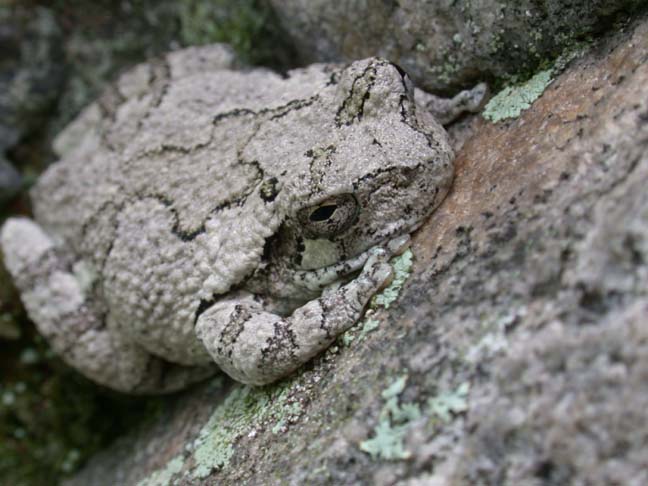
I was walking out the main door and we have a screen door after that that you also have to walk through and I noticed a splotch on the wood between the main door and screen door. Now without my glasses, there are quite a few things that look like splotches, but this one stood out to me because there wasn't ever anything on that wood. I paused and went back for a closer look and I saw it was a tree frog. I quickly went back inside and grabbed my glasses and got a very nice look at the little guy.

Grey Tree Frog (Hyla versicolor)
He was quite comfortably relaxing on the wood, but I didn't want him to get hurt if the door was slammed, so I scooped him up and brought him inside for a better look. Part of me had been hoping for the green variety, but I wasn't going to get that lucky. However, the grey coloration on him was beautiful. I wish I would have gotten a picture of my own, but he was much too hyper and my cat lightly batting at him made things a little more difficult. His climbing skills were in full show as he crawled up the wall, the oven, the cabinets...lots of climbing. It was very enjoyable to watch.

After letting him hop and climb around the kitchen for a while, I thought it would be best to put him back outside where he belongs. As I was about to let him go, he jumped from my fingers and landed on the siding of the house, sticking perfectly. He looked very content to sit there, so I just let him be since he was out of harm's way. When I came back in, he was gone, more than likely out on the hunt for some bugs to eat or to find a mate.

Enjoy our world everyone,

Bug

The Past Couple Weeks, Pt. 1

Hello everyone,

Sorry I have taken so long to write anything, these past couple weeks have been crazy for me. Lots and lots going on to get ready for moving to University of Illinois down in Champaign and finishing up a lovely summer class.

Instead of make one unbelievably long blog about what I have seen and done the past couple weeks, I thought it would just be easier to split it up into a few.

I returned to the prairie area next to Midway Village and got many good photos. Unfortunately I didn't see the bluebird again, but it was still a very good walk around. There were many interesting plants and flowers along with some birds and insects.

I don't know my plants as well as I should yet, but I'm still learning. Some that I saw at the prairie I've never actually seen before and they had a very interesting look. This one in particular caught my attention.


It appears to be a member of the thistle family. The flower has the same basic structure, as does the rest of the plant. It is tall and has many spines present. However, it is not the common thistle that we are all familiar with.

Bull thistle (Cirsium vulgare)
That is the thistle that people are more familiar with. It grows in fields and gets to be quite tall. The tallest I have ever seen was about 7 feet tall. These seem to be able to survive in a wide range of light conditions because I have seen them in full sun and in almost full shade before. A good, hardy species even if most people really do not like them because of their thorns. I like the coloration of the flowers when it blooms and I enjoy watching the many species of birds that flock to the seeds that come.

Goldfinch (Carduelis tristis)

Goldfinches are fun little birds that are very vocal during the spring and summer. They are very common and the males are very easy to spot because of their bright yellow coloration. They have a wide variety of calls that they make, but one that is a dead giveaway is a smaller questioning chirp. It really does sound like the little guy is asking a question of some sort, more than likely along the lines of "Where is a female for me?" There were four of them that were very busily plucking seeds from the thistles.

Another creature that was enjoying the thistles (though the flowers instead of the seeds), was an Eastern Tiger Swallowtail Butterfly. A beautiful species of butterfly that can be seen in Illinois around prairies, this one was enjoying some nectar of a very sweet thistle. One thing I have noticed about swallowtails is that they seem to like floating over highways. Could this be because they like feeling the warm updraft of air that is coming from all the vehicles zooming by underneath? It seems a little dangerous to me, but I have seen so many floating over that I really can't help but think that they somehow enjoy it.


Eastern Tiger Swallowtail Butterfly (Papilio glaucus)

I got to see an unbelievably beautiful flower while walking about. It was a dark red and had a distinct star shape.


Not sure what it was, but it was amazing to see. Almost more amazing than the flowers was a little hummingbird that flew up to drink from some of these. Hummingbirds love red, so these flowers were little beacons for the birds. As I leaned down to take this photo, a hummingbird flew up to within a foot of me and just looked me over before taking a sip from a nearby flower. I tried to turn my camera so I could get a shot of him, but he took off before I could and cheekily drank from a couple flowers before taking off for good. It was a great experience.

Keep looking around everyone and enjoy the beauty of nature around you,

Bug

Wednesday, July 27, 2011

We Rule the Night

Hello again my readers,

Last night I got to see a rare and beautiful sight. As I got ready to go to bed, I had my window open to let in some fresh air and to hopefully cool off my exceedingly warm room, and I heard a sound. I paused and listened because it sounded fairly far off and I heard it again. It was a sort of screeching sound, but definitely sounded distinctly bird like. I've had my suspicions of what it may be for quite some time, but never had a confirmation.

I've been hearing that sound during the summer for a few years now, with last year begin the most noticeable and memorable because of how many different birds there were making it at one time. It was also quite memorable because it was kind of freaky sounding and I was trying to find and bring my cat into the house because of all the coyotes we have around here.

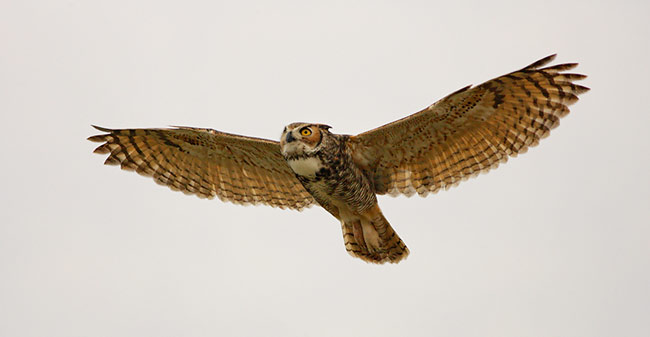
I looked out my window and was looking and listening. There are a ton of lightening bugs around here, so that all in itself was very pretty. But as I looked out across the backyard, I saw this shape drifiting across the sky. I focused more in on it as it flew closer to me. As it began to fly into my yard, it turned so that I was able to see the entire silhouette of a beautiful great horned owl as it flew into my woods. It was an amazing sight and I just stood by my window for a moment, hoping to see it again. Then the screeching sound began anew from the woods.


This was the basic silhouette of what I got to see. I wish it would have been during the day, so I could see all the detail, but seeing it in the night added some mysticism to it that really shows why the great horned owl is so revered.

It was not a sound that most people would expect from the regal great horned owl. Most people think of the owl as making its low pitched hooting during the night. The screech was unexpected, but shows that there are other ways for owls to communicate besides hooting. What was he/she chatting about with friends or its mate? I really don't know. But nevertheless, I enjoyed the conversation

Keep your eyes and ears open everyone,

Bug

Monday, July 25, 2011

Bug Log 1

Hello readers,

Every now and then I go on a big bug hunt to get an idea of what lives in the area and when I do, I always do my best to keep good notes and document everything I can. To keep things interesting, I will give only some of the best bugs i captured or saw.

This past Saturday (July 23, 2011), I was at Laona Forest Preserve in Durand, IL for a picnic for my cousin who had returned from military duty for a couple weeks. Another one of my cousins (who is much younger and much more curious) showed up a little while after I did. He was asking me questions about why I collect bugs (he was especially fascinated by the fact that I put them in the fridge, but he is only 4) and wanted  to go out and collect some with me.

I certainly didn't mind taking him around the picnic area to see what we could find. It was a beautiful forested area, edged by a field and open area of just grass. It was in the mid-80s, mostly cloudy, very humid, and a light occasional breeze drifted through.

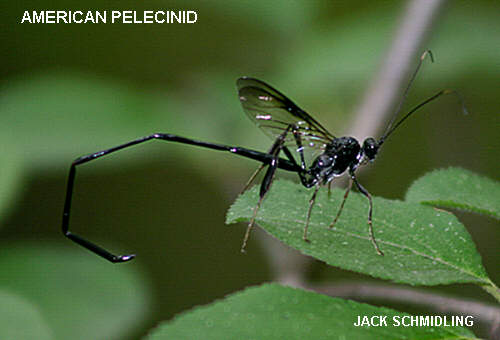
We began our search and we hadn't even been looking for 2 minutes when I noticed a wasp land in the grass nearby. Now normal people would just walk away, but this was a type of wasp I had been searching for for quite a while. So of course I saw 2 others over the next couple hours. It's all in where you look. The wasp that I caught was an American Pelecinid Wasp (Pelecinus polyturator).


While it looks like what the aliens in the Alien movies were based upon, it isn't quite that scary or intense. It has a long, very flexible abdomen that it uses to parasitize May beetle larvae aka grubs. The abdomen is very flexible and can easily poke into the ground to search for the larvae. Once the female locates one, she lays an egg in it. The larvae has no way of removing this pest and has no choice but to the be the buffet for the young wasp after it hatches and begins to grow. Many species of parasitic wasp grubs will actually eat carefully so that their host stays alive for as long as possible. Rather gruesome in a way, but a very good way to control pest insects should the need arise.

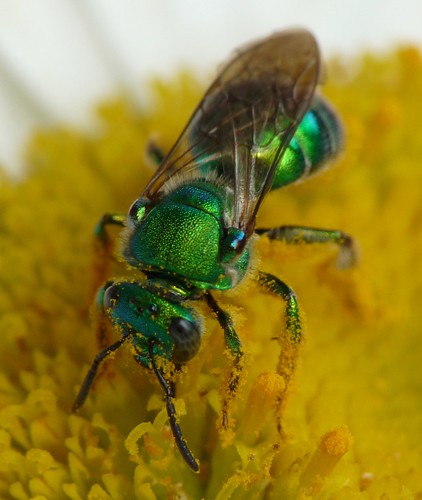
Besides catching that beauty, I also caught a type of sweat bee that I didn't know lived around here. It's the Green Sweat Bee (Agapostemon sp.). Unfortunately, I can't put an exact species to it at this point, but I'm going to keep working at it.


As I was walking around a tree (where I caught some good sized carpenter ants (Camponotus sp.)), I noticed a bright green blur buzzing around it. Ever curious, I waited for a moment to see if it came back and got lucky as I saw a small bee briefly land on the tree trunk. I tried to catch it, but wasn't quite quick enough. I was disappointed, but I would keep searching and hopefully find another.

My searching paid off as I found a whole hive of them nesting in a hollowed out tree trunk. It was a sight to see little flecks of green buzzing about the hollows of the dead wood. I watched for a few moments before figuring out a good place to make a capture. With all the hollows and canals left by previous residents, it was a challenge just to find a decent spot to try capturing one. I ended up getting my chance as one flew into a hole and I placed the jar over it. It was a good catch as I quickly scooted away to avoid disturbing the rest of the hive.

I did catch a few other insects while out, but these were the best captures of the day. I caught two other species of Hymenoptera, three Coleopterans, and a Hemipteran.

Watch out for something new every day,

Bug

Saturday, July 23, 2011

Lots and Lots of Lightning

Hello everyone,

The heat wave is finally beginning to wane for now. Thank goodness. And it has been replaced by some sweet thunderstorms. Even as I type this, there is another one rolling in. I know it really isn't doing all that much to knock the temp down, but it's still a nice change of pace (though it did knock out my power a couple times last night as I was typing this).

The lightning has been phenomenal. There has been such a show over the past couple days. Yesterday morning while I was on my way to work, I saw a couple very good strikes. One actually looked like two stick figures. Besides the shape of it, there was a pinkish coloration to it too, so that really added a special effect to it.

I went to a baseball game last night and there was a lot of lightning flashing in the distance. There was at least one strike per second. It was much more exciting than the game itself. The best thing about that storm in the distance though was the fact that I got to see it build up while the sun was still up. That was very entertaining because it set up in the classic cumulonimbus shape and the setting sun painted it many colors. And I could see even more of that storm and other separate storms on the way home.

But despite all the lightning action of the storms, there was a different kind of lightning that caught my attention and took my breath away.

While driving home from the baseball game, I looked to the left and saw a field full of lightning bugs (or fireflies if that is your preferred name) flashing. There had to be a few hundred of them floating and flashing about. It was a beautiful sight. I wish I would have had my camera with me to get a photo of my own.


This is about as close as I can get to what I saw, but this isn't even close to how beautiful it was

Lightning bugs (Photuris pyralis) are amazing creatures as they float about, flashing in their endless search for a mate. Being one of the unique creatures that bioluminesces, it uses this purely to show off and attract mates. The brighter the flash, the sexier the male is. But these flashes come at a price. Brighter flashes are easier to see by predators. Only the best males are able to survive and pass on their genes to the next generation. It's natural selection at work.

Until next time,

Bug