Sunday, August 14, 2011

A Pleasant Suprise

Hello everyone,

I had quite the suprise when I was going out my back door to take a dip in the pool.

I wear glasses normally, but take them off when I am going swimming. Needless to say, my vision is a bit affected by this change, so seeing things that aren't basically right in front of me is a challenge. So I was very shocked when I somehow found this little guy.

I was walking out the main door and we have a screen door after that that you also have to walk through and I noticed a splotch on the wood between the main door and screen door. Now without my glasses, there are quite a few things that look like splotches, but this one stood out to me because there wasn't ever anything on that wood. I paused and went back for a closer look and I saw it was a tree frog. I quickly went back inside and grabbed my glasses and got a very nice look at the little guy.

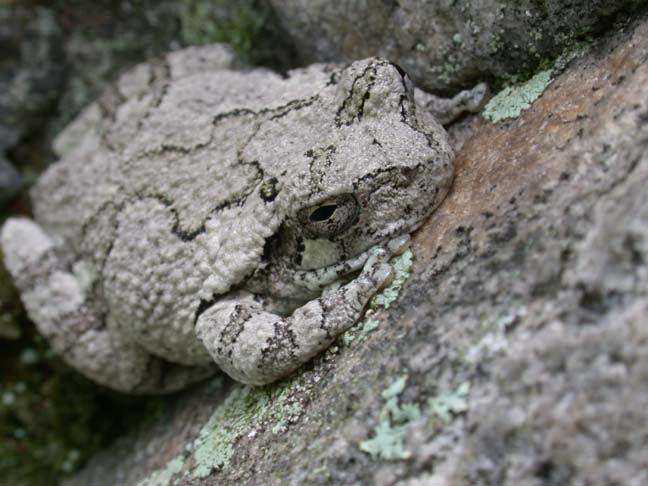
Grey Tree Frog (Hyla versicolor)
He was quite comfortably relaxing on the wood, but I didn't want him to get hurt if the door was slammed, so I scooped him up and brought him inside for a better look. Part of me had been hoping for the green variety, but I wasn't going to get that lucky. However, the grey coloration on him was beautiful. I wish I would have gotten a picture of my own, but he was much too hyper and my cat lightly batting at him made things a little more difficult. His climbing skills were in full show as he crawled up the wall, the oven, the cabinets...lots of climbing. It was very enjoyable to watch.

After letting him hop and climb around the kitchen for a while, I thought it would be best to put him back outside where he belongs. As I was about to let him go, he jumped from my fingers and landed on the siding of the house, sticking perfectly. He looked very content to sit there, so I just let him be since he was out of harm's way. When I came back in, he was gone, more than likely out on the hunt for some bugs to eat or to find a mate.

Enjoy our world everyone,

Bug

The Past Couple Weeks, Pt. 1

Hello everyone,

Sorry I have taken so long to write anything, these past couple weeks have been crazy for me. Lots and lots going on to get ready for moving to University of Illinois down in Champaign and finishing up a lovely summer class.

Instead of make one unbelievably long blog about what I have seen and done the past couple weeks, I thought it would just be easier to split it up into a few.

I returned to the prairie area next to Midway Village and got many good photos. Unfortunately I didn't see the bluebird again, but it was still a very good walk around. There were many interesting plants and flowers along with some birds and insects.

I don't know my plants as well as I should yet, but I'm still learning. Some that I saw at the prairie I've never actually seen before and they had a very interesting look. This one in particular caught my attention.


It appears to be a member of the thistle family. The flower has the same basic structure, as does the rest of the plant. It is tall and has many spines present. However, it is not the common thistle that we are all familiar with.

Bull thistle (Cirsium vulgare)
That is the thistle that people are more familiar with. It grows in fields and gets to be quite tall. The tallest I have ever seen was about 7 feet tall. These seem to be able to survive in a wide range of light conditions because I have seen them in full sun and in almost full shade before. A good, hardy species even if most people really do not like them because of their thorns. I like the coloration of the flowers when it blooms and I enjoy watching the many species of birds that flock to the seeds that come.

Goldfinch (Carduelis tristis)

Goldfinches are fun little birds that are very vocal during the spring and summer. They are very common and the males are very easy to spot because of their bright yellow coloration. They have a wide variety of calls that they make, but one that is a dead giveaway is a smaller questioning chirp. It really does sound like the little guy is asking a question of some sort, more than likely along the lines of "Where is a female for me?" There were four of them that were very busily plucking seeds from the thistles.

Another creature that was enjoying the thistles (though the flowers instead of the seeds), was an Eastern Tiger Swallowtail Butterfly. A beautiful species of butterfly that can be seen in Illinois around prairies, this one was enjoying some nectar of a very sweet thistle. One thing I have noticed about swallowtails is that they seem to like floating over highways. Could this be because they like feeling the warm updraft of air that is coming from all the vehicles zooming by underneath? It seems a little dangerous to me, but I have seen so many floating over that I really can't help but think that they somehow enjoy it.


Eastern Tiger Swallowtail Butterfly (Papilio glaucus)

I got to see an unbelievably beautiful flower while walking about. It was a dark red and had a distinct star shape.


Not sure what it was, but it was amazing to see. Almost more amazing than the flowers was a little hummingbird that flew up to drink from some of these. Hummingbirds love red, so these flowers were little beacons for the birds. As I leaned down to take this photo, a hummingbird flew up to within a foot of me and just looked me over before taking a sip from a nearby flower. I tried to turn my camera so I could get a shot of him, but he took off before I could and cheekily drank from a couple flowers before taking off for good. It was a great experience.

Keep looking around everyone and enjoy the beauty of nature around you,

Bug

Wednesday, July 27, 2011

We Rule the Night

Hello again my readers,

Last night I got to see a rare and beautiful sight. As I got ready to go to bed, I had my window open to let in some fresh air and to hopefully cool off my exceedingly warm room, and I heard a sound. I paused and listened because it sounded fairly far off and I heard it again. It was a sort of screeching sound, but definitely sounded distinctly bird like. I've had my suspicions of what it may be for quite some time, but never had a confirmation.

I've been hearing that sound during the summer for a few years now, with last year begin the most noticeable and memorable because of how many different birds there were making it at one time. It was also quite memorable because it was kind of freaky sounding and I was trying to find and bring my cat into the house because of all the coyotes we have around here.

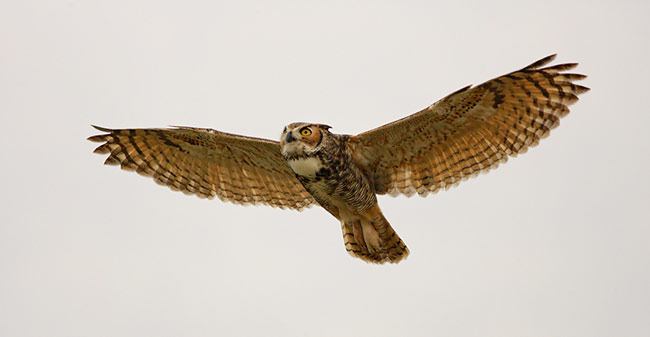
I looked out my window and was looking and listening. There are a ton of lightening bugs around here, so that all in itself was very pretty. But as I looked out across the backyard, I saw this shape drifiting across the sky. I focused more in on it as it flew closer to me. As it began to fly into my yard, it turned so that I was able to see the entire silhouette of a beautiful great horned owl as it flew into my woods. It was an amazing sight and I just stood by my window for a moment, hoping to see it again. Then the screeching sound began anew from the woods.


This was the basic silhouette of what I got to see. I wish it would have been during the day, so I could see all the detail, but seeing it in the night added some mysticism to it that really shows why the great horned owl is so revered.

It was not a sound that most people would expect from the regal great horned owl. Most people think of the owl as making its low pitched hooting during the night. The screech was unexpected, but shows that there are other ways for owls to communicate besides hooting. What was he/she chatting about with friends or its mate? I really don't know. But nevertheless, I enjoyed the conversation

Keep your eyes and ears open everyone,

Bug

Monday, July 25, 2011

Bug Log 1

Hello readers,

Every now and then I go on a big bug hunt to get an idea of what lives in the area and when I do, I always do my best to keep good notes and document everything I can. To keep things interesting, I will give only some of the best bugs i captured or saw.

This past Saturday (July 23, 2011), I was at Laona Forest Preserve in Durand, IL for a picnic for my cousin who had returned from military duty for a couple weeks. Another one of my cousins (who is much younger and much more curious) showed up a little while after I did. He was asking me questions about why I collect bugs (he was especially fascinated by the fact that I put them in the fridge, but he is only 4) and wanted  to go out and collect some with me.

I certainly didn't mind taking him around the picnic area to see what we could find. It was a beautiful forested area, edged by a field and open area of just grass. It was in the mid-80s, mostly cloudy, very humid, and a light occasional breeze drifted through.

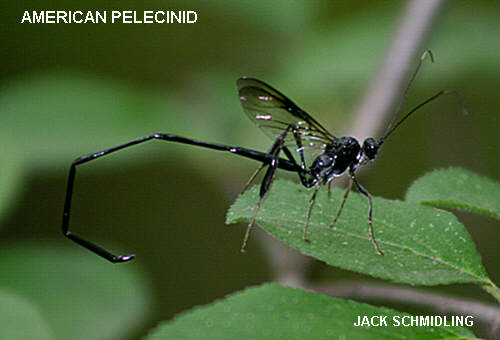
We began our search and we hadn't even been looking for 2 minutes when I noticed a wasp land in the grass nearby. Now normal people would just walk away, but this was a type of wasp I had been searching for for quite a while. So of course I saw 2 others over the next couple hours. It's all in where you look. The wasp that I caught was an American Pelecinid Wasp (Pelecinus polyturator).


While it looks like what the aliens in the Alien movies were based upon, it isn't quite that scary or intense. It has a long, very flexible abdomen that it uses to parasitize May beetle larvae aka grubs. The abdomen is very flexible and can easily poke into the ground to search for the larvae. Once the female locates one, she lays an egg in it. The larvae has no way of removing this pest and has no choice but to the be the buffet for the young wasp after it hatches and begins to grow. Many species of parasitic wasp grubs will actually eat carefully so that their host stays alive for as long as possible. Rather gruesome in a way, but a very good way to control pest insects should the need arise.

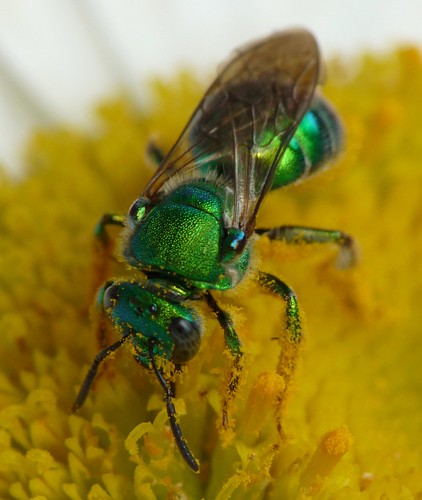
Besides catching that beauty, I also caught a type of sweat bee that I didn't know lived around here. It's the Green Sweat Bee (Agapostemon sp.). Unfortunately, I can't put an exact species to it at this point, but I'm going to keep working at it.


As I was walking around a tree (where I caught some good sized carpenter ants (Camponotus sp.)), I noticed a bright green blur buzzing around it. Ever curious, I waited for a moment to see if it came back and got lucky as I saw a small bee briefly land on the tree trunk. I tried to catch it, but wasn't quite quick enough. I was disappointed, but I would keep searching and hopefully find another.

My searching paid off as I found a whole hive of them nesting in a hollowed out tree trunk. It was a sight to see little flecks of green buzzing about the hollows of the dead wood. I watched for a few moments before figuring out a good place to make a capture. With all the hollows and canals left by previous residents, it was a challenge just to find a decent spot to try capturing one. I ended up getting my chance as one flew into a hole and I placed the jar over it. It was a good catch as I quickly scooted away to avoid disturbing the rest of the hive.

I did catch a few other insects while out, but these were the best captures of the day. I caught two other species of Hymenoptera, three Coleopterans, and a Hemipteran.

Watch out for something new every day,

Bug

Saturday, July 23, 2011

Lots and Lots of Lightning

Hello everyone,

The heat wave is finally beginning to wane for now. Thank goodness. And it has been replaced by some sweet thunderstorms. Even as I type this, there is another one rolling in. I know it really isn't doing all that much to knock the temp down, but it's still a nice change of pace (though it did knock out my power a couple times last night as I was typing this).

The lightning has been phenomenal. There has been such a show over the past couple days. Yesterday morning while I was on my way to work, I saw a couple very good strikes. One actually looked like two stick figures. Besides the shape of it, there was a pinkish coloration to it too, so that really added a special effect to it.

I went to a baseball game last night and there was a lot of lightning flashing in the distance. There was at least one strike per second. It was much more exciting than the game itself. The best thing about that storm in the distance though was the fact that I got to see it build up while the sun was still up. That was very entertaining because it set up in the classic cumulonimbus shape and the setting sun painted it many colors. And I could see even more of that storm and other separate storms on the way home.

But despite all the lightning action of the storms, there was a different kind of lightning that caught my attention and took my breath away.

While driving home from the baseball game, I looked to the left and saw a field full of lightning bugs (or fireflies if that is your preferred name) flashing. There had to be a few hundred of them floating and flashing about. It was a beautiful sight. I wish I would have had my camera with me to get a photo of my own.


This is about as close as I can get to what I saw, but this isn't even close to how beautiful it was

Lightning bugs (Photuris pyralis) are amazing creatures as they float about, flashing in their endless search for a mate. Being one of the unique creatures that bioluminesces, it uses this purely to show off and attract mates. The brighter the flash, the sexier the male is. But these flashes come at a price. Brighter flashes are easier to see by predators. Only the best males are able to survive and pass on their genes to the next generation. It's natural selection at work.

Until next time,

Bug

Tuesday, July 19, 2011

Special Heat Wave Edition

Hello my hopefully reasonably cool readers,

The heat wave has certainly hit the Midwest with full force. Good lord. If it was just the heat, I think we would all be fine, but the killer is the blasted humidity. I seriously feel like I'm trying to walk through a viscous substance instead of just regular, old air. It's just too freaking hot to be outside exploring right now.

So I thought we would have a special heat wave edition of the blog today. The adaptations of the natural world are quite astounding when it comes to beating the heat. It all depends on what you are. Plants of course are going to protect themselves differently than animals will. So we will start out with a plant or two.

A favorite of mine (and I suspect many other people even though they don't know it) is the aloe plant. There are about 400 species of aloe that are currently known. It is a desert dwelling plant from Africa that has very fleshy leaves that hold most of the water. While this may set it up to be eaten by many herbivores hoping for a little "juice" to with their meal, the aloe has a defense of many spines running up both edges of its leaves.


Aloe is a popular plant to people because of its medicinal properties. It's used to make aloe vera, which does a very good job of soothing sunburns and bug bites. There are also cases of it being used as a powerful laxative. Not the way most people would imagine (or want!) it used, but it shows the what the plant is capable of giving us.

The liquid inside a broken leaf. It heals quite quickly to save water loss.


While the lovely green product you may use comes in a tube, if you have an aloe plant at home, you can actually just break off the tip of a leaf and spread the fluid that comes out on a bug bite or small sunburn and it will do quite a bit to get the itching, burning feeling to stop.

The aloe plant is able to hold so much moisture in because of the way the leaves are set up. The walls of the cells are much thinker than in normal plants because of the dire need to conserve water. Each leaf is completely smooth to reduce the surface area and decrease the areas where water can be lost. And while the aloe takes in sunlight during the day, it doesn't actually use the sunlight to make sugar until the night falls and it is able to open its stomata. This is a fairly common way for plants in a xeric environment to conserve water but still get the energy they need.


As for a couple well-adapted warm weather animals, I want to introduce a couple that really are not as well known.

A personal favorite of mine is the darkling beetle, Eleodes sp. It is a rather common beetle in all ecosystems around the world, but the desert dwelling species are very specially adapted for life in the desert.

Darkling beetle I found when I visited Utah in summer of 2010

Darkling beetles have a very unique way of obtaining water, depending on where they live. Most actually don't drink anything; they just extract the water from what they eat. But there are certain species that will take in what water they can from fog that blows in over the sand dunes. They stand with their backs to the incoming fog. As the breeze blows the fog over them, they angle their abdomens upward so that the water droplets hit the abdomen and flow down to the beetles mouth. This is made possible because the beetle's wings are fused together (to prevent water loss) and it allows the water to easily run across the exoskeleton to the mouth. A very good adaptation to a very harsh lifestyle.

Another favorite of mine is the Harris hawk, Parabuteo unicinctus. It's different than normal hawks because it hunts in small groups. This is extremely uncommon behavior in the raptor world. They do this because it increases the chance of a successful kill to feed the group.

A Harris hawk perched in a tree

I actually got to have the honor to see these magnificent birds fly together when I was in Arizona. It was grand to watch. They used communication as well as just watching each other to hunt down and capture the prey. The best thing about the demonstration the park did with them was that they didn't just release an animal for the hawks to hunt. They actually let the hawks go out and hunt by themselves. It took them about 10 minutes, but they eventually came back, one carrying a jackrabbit they had found.

Another reason they hunt in groups like that is because they have more eyes to the ground and can work together to flush prey out. There really is very little that can scare a small animal like the shadow of a hawk shooting across the ground. By having one member of the group scare the prey out, that gives the others a chance to swoop down and grab it. It works quite well and gives them a distinct advantage for survival in the harsh desert.

Stay cool everyone,

Bug
Saturday, July 16, 2011

Things Begin to Heat Up

Hello readers,

Are you all ready for this lovely heat wave that's going to hit Illinois? Gotta love the mid to high 90 degree weather.

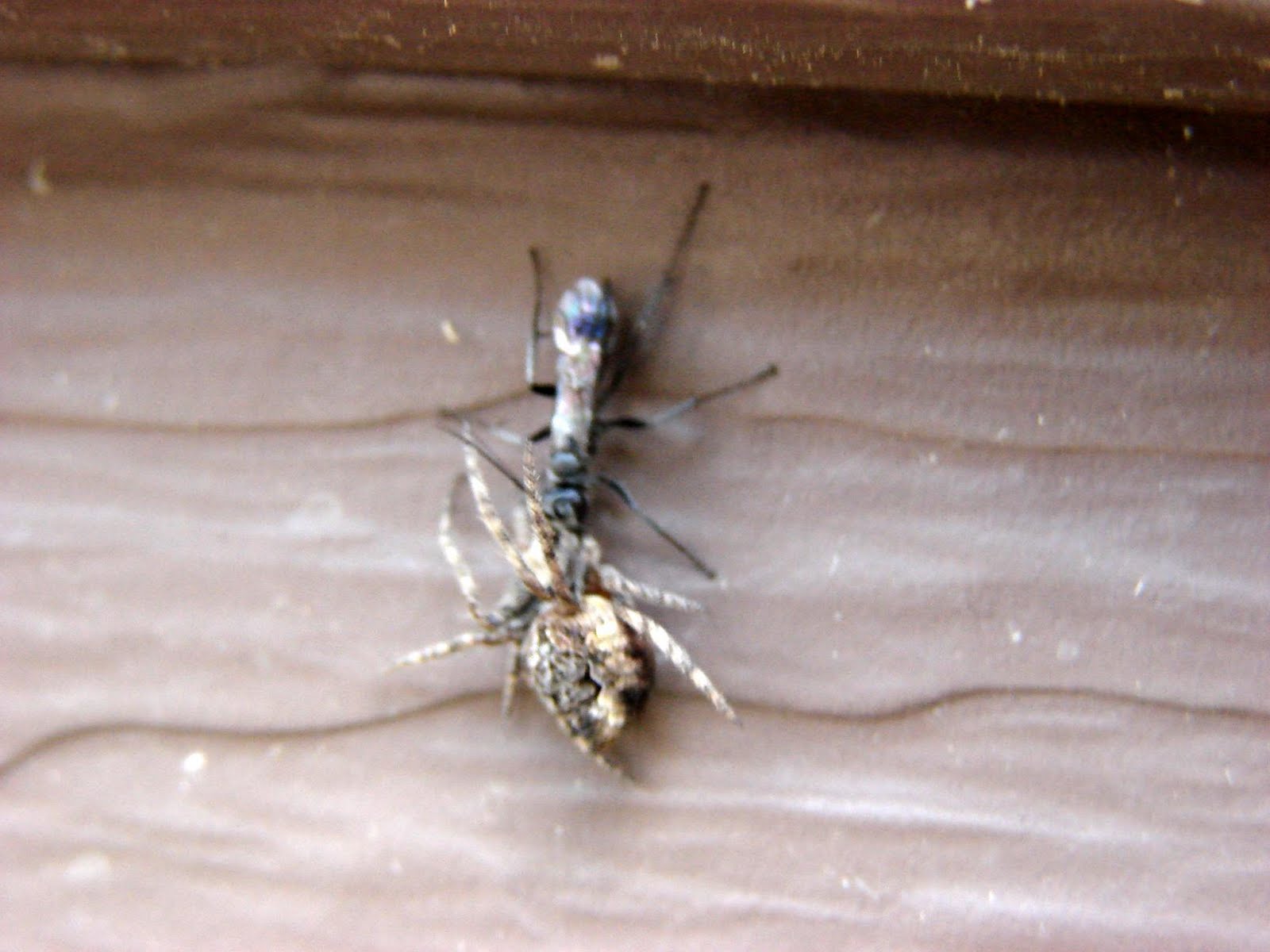
As I was helping clean up a little bit, I went outside to throw out some old food into the woods, and I noticed some movement on the side of the house near the door. Upon closer inspection, I saw that it was a wasp trying to pull a large house spider up the side of the house.

The wasp is Anoplius sp. or the Blue-black spider wasps


Nice close-up of the two

It was a bit of a suprise to see something like that on the side of the house. I would expect to see something like that a little farther out away from the house where the wasp could drag it under cover more easily than having to drag it all the way across the deck. A lot of effort has to be expended and the spider may wake back up before the wasp gets it away. Venom is costly to make and the wasp probably can't deal with another costly fight with the spider with the possibility of getting killed.

Once the wasp has found a suitable place to leave the spider, it will lay an egg that will hatch and the grub that comes out will consume the still very alive spider. It's a nasty way for the spider to go and I was tempted to save the spider, but that's the way things go and I wasn't going to let the spider give up a hard earned meal for it's young.

Another part of the day was when my family and I went for a walk by Midway Village around the prairie area. We started the walk by the pond, where my curiosity/fascination with water got the best of me and I went down to the water's edge to see many ripples moving rapidly my way. It was a little freaky until I realized it was just a very large school of fishes (I can say fishes because it was more than one species of fish in the school).

As we walked around the prairie area, there were many different species of birds flying around. Many a goldfinch were flying around with their questioning sounding chirps sounding from all around. Their call always makes me smile. But one call in particular caught my attention because of its complexity and how clear it was. I looked around for it and saw a flash of blue at the top of a tree before it landed briefly on the ground and then took off across the prairie. It was a beautiful species of bluebird. I believe it was an eastern bluebird, but am unsure because I didn't get the greatest view of its breast, so I'm not sure if it had the pretty orange color. If I would have had my camera with me, I would have snapped a quick photo. A very vibrant blue plummage all across its back and wings and extending up onto its head where the color tapered off to a slightly more subdued shade. It was such a lovely sight. I wish it would have stayed so I could have seen and heard more, but off it flew. I hope to be lucky enough to see another sometime soon.


My best guess to what it was, the Eastern Bluebird

All in all a very good day just for the brief time I was outside!

Stay cool everyone,

Bug